

The conventional narrative of home education is dominated by a persistent cultural stereotype: a two-parent household wherein one spouse earns a comfortable full-time income while the other serves as the full-time domestic educator. For millions of single mothers, single fathers, and solo parent entrepreneurs, this archetype feels not only alienating but practically insurmountable. When you are the sole breadwinner, the sole administrator, the sole cook, and the sole educator, attempting to follow a traditional 9:00 AM to 3:00 PM homeschool schedule is a guaranteed recipe for physical and emotional exhaustion.
Yet single parent homeschooling is one of the fastest-growing demographics in modern education. Solo parents are discovering that home education does not require two adults or forty hours of kitchen-table lecturing. In reality, an elementary child only requires 60 to 90 minutes of direct, one-on-one instruction per day; middle schoolers thrive on 90 to 120 minutes; and high schoolers function primarily as independent, self-directed scholars under parental mentorship.
By dismantling the institutional timetable and replacing it with high-autonomy physical workstations, a predictable tri-phase daily rhythm, and strategic community barter networks, single parents can build a peaceful, academically rigorous home education that protects both their livelihood and their mental well-being.
Deconstructing the “Two-Parent” Myth: The Efficiency Advantage
In a conventional public or private classroom, a teacher must manage twenty-five students with differing behavioral needs, bathroom schedules, administrative announcements, and pedagogical paces. Consequently, only about 20% to 25% of the school day consists of active, cognitive learning. The rest is institutional maintenance.
When you homeschool as a single parent, your instructional ratio is 1:1 or 1:2. What takes an institutional classroom an entire week to cover in mathematics can frequently be mastered in two 30-minute one-on-one tutoring sessions at home.
The Single Parent's Efficiency Multiplier
Because you have zero institutional friction, you do not need 30 hours of instruction each week. A single parent who provides 10 to 12 focused hours of weekly academic engagement easily surpasses the academic depth of an institutional classroom. Homeschooling is not about adding a second 40-hour job to your life; it is about replacing rigid school-district bureaucracy with concentrated, relationship-based learning sprints.
Visual Architecture: The Solo Parent Sustainability Model
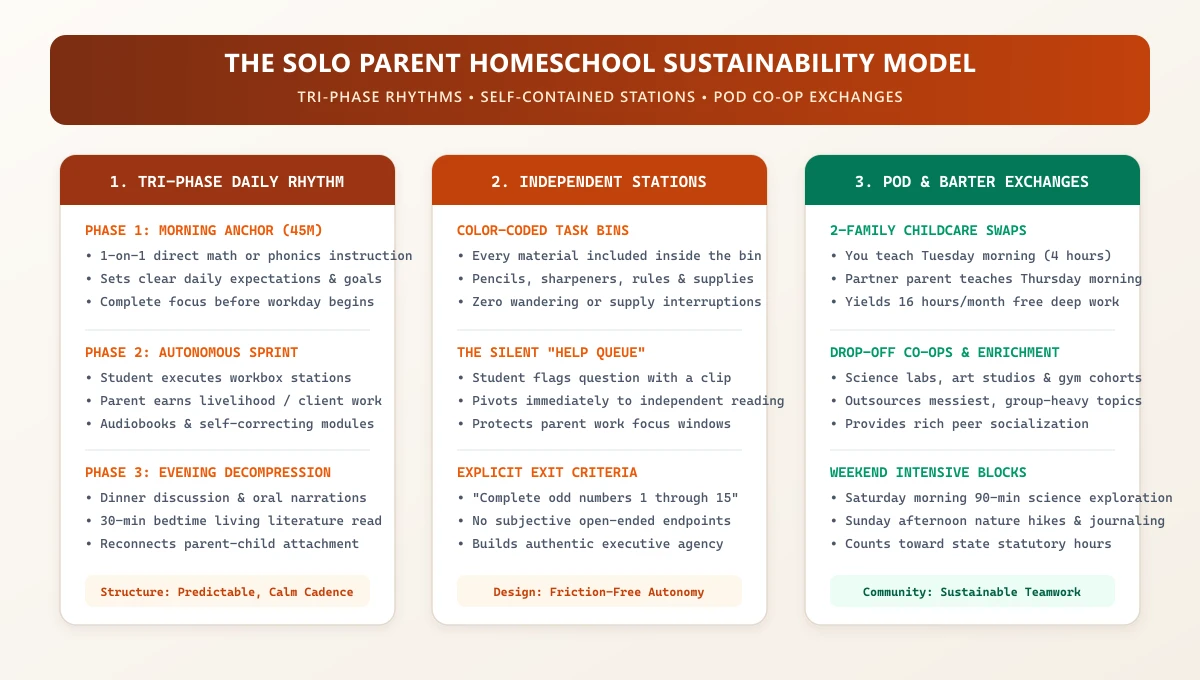
Pillar 1: The Tri-Phase Daily Rhythm
Trying to teach in unpredictable 10-minute fragments while answering work emails or cooking meals creates severe emotional strain for both parent and child. Instead, organize your day into three distinct, non-overlapping phases:
Phase 1: The Morning Connection Anchor (45–60 Minutes)
Before you open your laptop, answer client calls, or dive into daily chores, dedicate 45 to 60 uninterrupted minutes exclusively to your children.
- 15 Minutes: Shared breakfast, poetry reading, or conversational current events.
- 30 to 45 Minutes: Direct, guided instruction in high-leverage foundational subjects—specifically, mathematics concepts and phonics/writing mechanics.
By completing direct instruction first thing in the morning, your child’s emotional cup is filled, and the hardest cognitive hurdle of the day is already conquered before your workday officially starts.
Phase 2: The Autonomous Work Sprint (2 to 4 Hours)
During the middle of the day, the parent focuses on professional employment, client calls, or remote work. Meanwhile, the child moves through pre-arranged independent learning modules:
- Audiobooks and literature reading
- Handwriting practice and copywork
- Self-correcting math problem sets
- Educational typing, coding, or foreign language apps
- Open-ended art, handicrafts, or Lego engineering challenges
The golden rule of Phase 2 is frictionless autonomy: the child must have all materials and clear instructions in hand so they never have to interrupt your work to ask, “What do I do next?”
Phase 3: The Twilight Living Books & Decompression Block (45 Minutes)
Content subjects such as history, geography, and natural science should not compete with your busy afternoon workday. Move them to the evening.
Gather on the couch or around the dinner table after work has wrapped up. Read a chapter from a rich historical narrative (such as Story of the World or a biographical living book), discuss it together, and have your child narrate what they learned. This transforms academic study into a relaxing, relational family wind-down routine that requires zero grading or administrative stress.
Pillar 2: Engineering Self-Contained Workstations
If a child has to search through drawers for a pencil, hunt down an eraser, or ask where their workbook is, their attention scatters and interruptions multiply. Independence is built through physical environment design.
The 4-Bin Workbox System
Invest in a vertical cart with four distinct drawers or clear plastic bins labeled 1, 2, 3, and 4:
| Station Bin | Focus Area | Materials Included Inside | Exit Criteria |
|---|---|---|---|
| Bin 1: Math Practice | Problem fluency & review | Workbook, sharpened pencil, scratch pad, manipulative blocks | “Complete odd-numbered problems 1–15” |
| Bin 2: Language Arts | Spelling dictation or handwriting | Copywork book, pen, colored markers | “Copy stanza 2 in best cursive” |
| Bin 3: Content Audio | History or science exploration | Tablet with pre-downloaded audiobook, headphones, sketching pad | “Listen to Chapter 4 and draw one scene” |
| Bin 4: Tactile Inquiry | Hands-on construction or puzzle | Logic puzzle book, origami paper, or nature specimen to dissect | “Solve Puzzle 12 or fold 2 models” |
When the child finishes Bin 1, they physically slide it shut and move to Bin 2. Because every tool is self-contained and the exit criteria are explicit, the child experiences a clear sense of momentum and accomplishment.
The Silent “Help Queue” Protocol
When a single parent is on an important client call or deep in a deadline sprint, interruptions must be minimized. Teach your children the Help Queue habit:
The Visual Help Clip Protocol
When a student gets stuck on a difficult math problem or comprehension question during their independent sprint, they are taught never to knock on the door or yell across the room. Instead, they place a red clothespin on the page, set that bin aside, and immediately proceed to the next bin. During your scheduled lunch break, you review all clipped items together in one concentrated 10-minute session.
This single protocol eliminates 90% of mid-day household friction and nurtures profound executive function skills in young learners.
Pillar 3: Micro-Co-Ops and the 2-Family Childcare Barter
No single parent is an island. Attempting to provide 100% of childcare, 100% of instruction, and 100% of income in complete isolation inevitably leads to caregiver burnout. The secret weapon of successful solo homeschoolers is collaborative bartering.
The 2-Family Co-Op Exchange
Find one other homeschooling family—ideally another working or solo parent with children of similar ages—and establish a formal reciprocal childcare agreement:
- Tuesday Mornings (9:00 AM – 1:00 PM): You host all the children at your home. You lead science experiments, group art, or outdoor sports while the other parent enjoys four solid hours of uninterrupted work or rest.
- Thursday Mornings (9:00 AM – 1:00 PM): The other parent hosts all the children, leading history and group reading while you execute your deepest professional work sprints.
Without spending a single dollar on private tutoring or daycare, both families gain 16 hours of dedicated work time every month, and the children enjoy regular, structured socialization with close friends.
Strategic Drop-Off Enrichment Classes
Outsource your highest-mess and highest-socialization subjects to local community resources:
- Homeschool Gymnastics & Swim Programs: Offered during non-peak weekday morning hours at steep discounts compared to weekend classes.
- Library STEM & Maker Clubs: Free, high-quality coding and robotics workshops hosted by regional public library systems.
- Forest School & Nature Cohorts: Weekly 3-to-4 hour outdoor immersion groups that provide vigorous physical exercise and nature study under experienced naturalists.
Legal Compliance: Meeting State Hours on a Solo Schedule
Single parents frequently ask whether non-traditional school schedules satisfy state homeschooling statutes. In all 50 states, homeschooling laws grant parents broad discretion regarding when and how instructional hours are accumulated.
- Evening and Weekend Instruction: State statutes mandate hours or days of instruction; they virtually never dictate that learning must occur between 8:00 AM and 3:00 PM on weekdays. Saturday morning trips to the botanical garden, Sunday afternoon science experiments, and evening literature discussions are legally valid instructional time.
- Year-Round Pacing: Rather than squeezing 180 school days into a compressed 9-month calendar, spread your 180 days across all 52 weeks (approx. 3.5 days per week). This prevents summer learning loss, dramatically lowers daily stress, and allows you to take vacations during off-peak seasons when travel costs are lowest.
Emotional Health: Preserving the Sacred Parent-Child Bond
When you carry the full weight of a household on your shoulders, it is dangerously easy for parenting to become entirely managerial. Every conversation can devolve into: “Did you finish your math? Have you brushed your teeth? Put your shoes away.”
To protect your family’s joy, establish one non-negotiable rule: The Sabbath Afternoon. Designate at least one afternoon per week—whether Sunday, Friday, or Wednesday—where all workbooks remain closed, all professional laptops are powered down, and your only agenda is connection. Bake bread together, explore a state park hiking trail, or snuggle under blankets with an audio drama.
Single parent homeschooling is not a compromise; it is an empowering educational choice. By giving your children a front-row seat to your resilience, resourcefulness, and dedication, you are modeling life lessons that no textbook could ever teach. With realistic rhythms, organized workstations, and a supportive community, you can cultivate an extraordinary home education that transforms your entire family.
Disclaimer
Disclaimer: This post is for informational and educational purposes only, accurate to the best of our knowledge at publication. It does not constitute advice. We do not guarantee accuracy or completeness and accept no liability for any decisions or losses resulting from reliance on this content.