

Disclaimer: This post is for informational and educational purposes only, accurate to the best of our knowledge at publication. It does not constitute advice. We do not guarantee accuracy or completeness and accept no liability for any decisions or losses resulting from reliance on this content.
For nearly a century, when a homeschooling child struggled with dyslexia or decoding, the universal answer was Orton-Gillingham (O-G). Rooted in the 1930s neuropsychiatric work of Dr. Samuel Orton and educator Anna Gillingham, traditional O-G programs (such as Barton, All About Reading, Logic of English, and Wilson) became the undisputed gold standard of multi-sensory reading intervention.
However, in recent years, cognitive neuroscientists, speech-language pathologists, and reading clinicians have sparked a major paradigm shift: Speech-to-Print Linguistic Phonics (championed by programs like Sounds-Write, Reading Simplified, EBLI, and Phono-Graphix).
While both philosophies belong to the evidence-based Science of Reading (Structured Literacy) umbrella and reject whole-language guessing, their instructional vectors, cognitive demands, and treatment of English spelling rules differ radically.
For a homeschooling parent trying to teach a dyslexic 7-year-old or remediate a frustrated 10-year-old reader, understanding the real-world differences between Speech-to-Print and Orton-Gillingham can save years of instructional tears and hundreds of dollars in curriculum investments.
1. The Core Philosophical Divide: Which Direction Does Phonics Flow?
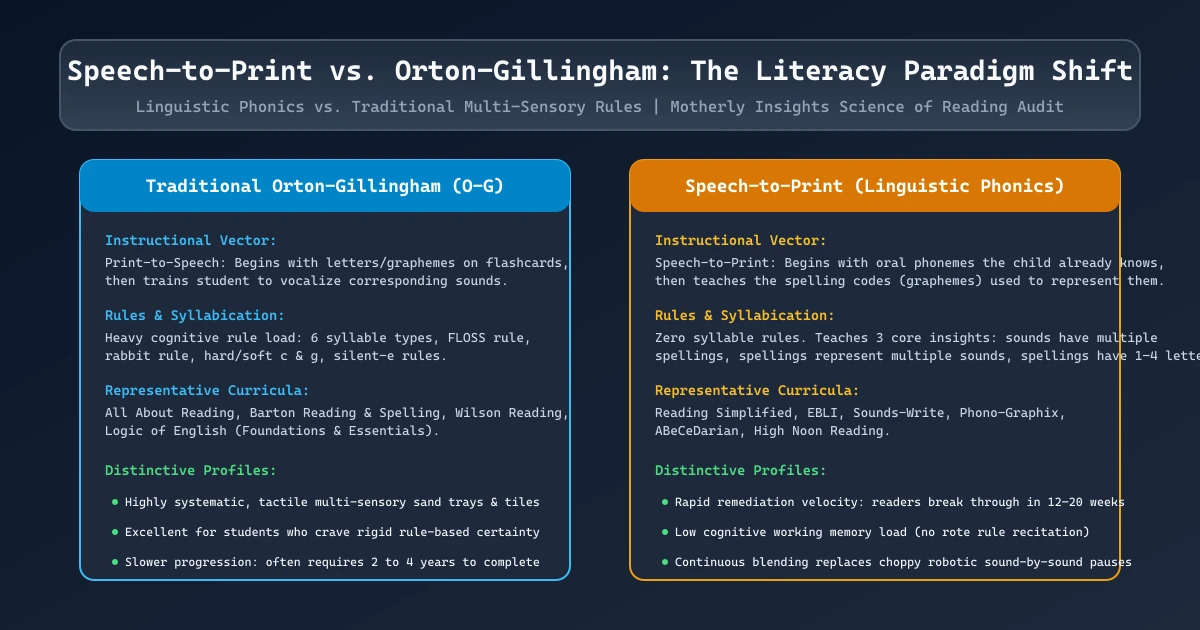
The fundamental disagreement between traditional Orton-Gillingham and Speech-to-Print centers on the directionality of code acquisition:
Orton-Gillingham: Print-to-Speech
Traditional O-G begins with the abstract written symbol (the letter/grapheme) and trains the child to convert that visual shape into an oral sound.
- The O-G Instructional Prompt: “Look at this card with the letters ‘O-A’. What sound does ‘O-A’ make?”
- The Cognitive Path: Visual Orthography $ ightarrow$ Phonological Retrieval $ ightarrow$ Vocal Articulation.
Because human beings did not evolve to read print—our brains only developed the capacity for spoken language over hundreds of thousands of years—starting with arbitrary visual squiggles places a heavy tax on working memory and visual-phonological mapping circuits.
Speech-to-Print (Linguistic Phonics): Speech-to-Print
Linguistic Phonics flips the instructional vector 180 degrees. It recognizes that every child arrives at reading already possessing a sophisticated spoken vocabulary. Spoken English comprises approximately 44 speech sounds (phonemes). Written English is simply a man-made technology invented to record those 44 sounds on paper.
- The Speech-to-Print Instructional Prompt: “Say the word boat. What sounds do you hear in boat? /b/ - /oa/ - /t/. Now, let’s write the sound /oa/ using the letters ‘o-a’.”
- The Cognitive Path: Oral Phonology (Already Mastered) $ ightarrow$ Orthographic Mapping $ ightarrow$ Print Production.
By anchoring instruction in the spoken words already wired into the child’s auditory cortex, Speech-to-Print leverages the brain’s natural linguistic hardwiring.
2. Rules vs. Insights: The Syllable Division Controversy
Perhaps the most dramatic day-to-day difference in your homeschool room is how each approach handles multi-syllabic words and spelling irregularities.
| Linguistic Feature | Traditional Orton-Gillingham (O-G) | Speech-to-Print (Linguistic Phonics) |
|---|---|---|
| Syllable Instruction | Teaches 6 Formal Syllable Types (Closed, Open, VCe, Vowel Team, R-Controlled, Consonant-le) and complex syllable division patterns (VCCV, VCV, VCCCV). | Zero syllable rules. Multi-syllabic words are read by chunking syllables orally (e.g., fan-tas-tic), matching each spoken syllable to its phonemic spellings. |
| Spelling Rules | Memorizes dozens of explicit phonetic rules: the FLOSS rule, Rabbit rule, 1-1-1 doubling rule, “c says /s/ before e, i, y”, gentle-cindy rule. | Three Core Organizing Insights: 1. Sounds are represented by letters (1–4 letters). 2. A sound can be spelled in multiple ways. 3. A spelling can represent multiple sounds. |
| Handling Vowel Teams | Taught rigidly and sequentially: teaches one spelling pattern at a time, often taking months before introducing alternate sounds for ea (as in meat, bread, steak). | Taught simultaneously (Set for Diversity): Teaches the sound /oa/ and immediately shows the child that /oa/ can be spelled oa (boat), ow (snow), o_e (bone), and o (go). |
| Blending Technique | Often uses segmented blending: “/k/ - /a/ - /t/ $ | |
| ightarrow$ cat“. In struggling kids, this produces robotic pauses and memory decay. | Continuous Blending: The child stretches and sings through sounds without stopping: “caaaat $ | |
| ightarrow$ cat“, preserving working memory. |
The Problem with O-G’s “Rule Heavy” Cognitive Load
For children with strong working memory, O-G rules provide a comforting, algebraic structure. But for the 60% to 70% of dyslexic learners who also struggle with working memory and processing speed deficits, memorizing 40+ abstract rules is overwhelming.
When an 8-year-old encounters the word muffin in an O-G lesson, they are often asked to:
- Label the vowels (V).
- Label the consonants between them (C-C).
- Identify the pattern as VCCV.
- Divide between the consonants (muf-fin).
- Identify the first syllable as a “Closed Syllable”.
- Conclude that the vowel must be short /u/.
By the time the child works through this six-step algorithm, their cognitive energy is completely drained, and they have forgotten the context of the story.
Speech-to-Print bypasses this entirely: the child is taught to say the spoken syllables (muf-fin), blend them continuously, and flex the vowel sound if it doesn’t sound like a real English word.
3. Remediation Velocity: How Fast Do Children Learn to Read?
One of the most compelling arguments for Speech-to-Print in home education is speed of remediation:
- Traditional Orton-Gillingham Timeline: Programs like Barton Reading & Spelling consist of 10 dense levels. Barton explicitly notes that completing the full system typically takes 2 to 3 years of consistent, 4-day-a-week tutoring.
- Speech-to-Print Timeline: Programs like Reading Simplified (Dr. Marnie Ginsberg) or Sounds-Write typically achieve functional fluency and decoding independence within 12 to 20 weeks.
Because Speech-to-Print does not gatekeep reading behind hundreds of isolated phonics rules, children begin reading authentic, connected decodable text within their very first month of study.
4. Top Curricula in Each Camp: A Homeschooler’s Guide
The Premier Orton-Gillingham Programs
- All About Reading (AAR): The most beloved O-G curriculum in homeschooling. Highly scripted, beautifully illustrated, utilizes color-coded magnetic letter tiles, phonogram flashcards, and delightful hardcover decodable readers. Excellent for parents who want step-by-step guidance.
- Logic of English (Foundations & Essentials): Authored by Denise Eide (Uncovering the Logic of English). Exceptionally rigorous, teaches all 75 phonograms and 31 spelling rules. Integrates handwriting, spelling, and grammar simultaneously.
- Barton Reading & Spelling: The gold-standard clinical dyslexia intervention. Very expensive and strictly scripted, designed so that any parent can deliver clinical-grade multi-sensory dyslexia tutoring at home without a master’s degree.
The Premier Speech-to-Print (Linguistic Phonics) Programs
- Reading Simplified (Dr. Marnie Ginsberg): An extraordinarily streamlined online parent framework. Utilizes five core multi-sensory activities (Build It, Switch It, Read It, Sort It, Write It) that integrate phonemic awareness, phonics, and handwriting in every 20-minute lesson.
- Sounds-Write: The world-renowned UK linguistic phonics curriculum (now widely used across Australia and North America). Highly structured, deeply evidence-based, training children to manipulate sounds in words using simple dry-erase boards.
- EBLI (Evidence-Based Literacy Instruction): A powerful, fast-acting speech-to-print system developed by Nora Chahbazi. Famous for remediating older struggling readers and adults in record time.
- Phono-Graphix: The original groundbreaking speech-to-print program developed by Carmen and Geoffrey McGuinness (Why Our Children Can’t Read). Accessible via affordable parent workbooks.
5. Head-to-Head Comparison Matrix
| Practical Metric | Orton-Gillingham (O-G) | Speech-to-Print (Linguistic Phonics) |
|---|---|---|
| Multi-Sensory Components | High: Sand trays, sky-writing, tapping fingers, magnetic letter tiles, color-coded morpheme cards. | Medium: Whiteboard markers, physical word-building tiles, oral stretch-and-blend exercises. |
| Parent Prep Demand | Moderate to High: Must organize extensive card packs, tile boards, teacher manuals, and progress charts. | Low to Moderate: Requires internalizing the 5 core activities, then uses a simple dry-erase board and decodables. |
| Best For… | Children with severe speech apraxia; learners who thrive on tactile routines and rigid rule systems. | Dyslexic learners with working memory exhaustion; older struggling readers (grades 3–8) needing rapid remediation. |
| Sight Word Treatment | Memorized on “red cards” or “jail cards” as irregular phonetic exceptions. | Decoded phonetically: teaches that nearly all “sight words” have only one unexpected sound-spelling match. |
| Cost Profile | $150 – $350+ per level (frequently $600–$1,200 across elementary years). | $80 – $250 total (streamlined workbooks or digital parent training modules). |
6. Clinical Conclusion: Which Approach Should You Choose?
Both Orton-Gillingham and Speech-to-Print represent immense advancements over the discredited three-cueing / balanced literacy methods that failed a generation of students in public schools.
Choose Traditional Orton-Gillingham (like All About Reading or Logic of English) if your child is in kindergarten or 1st grade, loves tactile manipulatives, letter tiles, and games, and benefits from a slow, predictable, highly methodical rule-based march through phonics.
Choose Speech-to-Print (like Reading Simplified or Sounds-Write) if you are working with a child who has stalled in traditional phonics, a dyslexic learner who collapses into tears when asked to memorize syllable division rules, or an older 3rd-to-6th grader who needs their reading fluency unlocked in months rather than years.
By matching your child’s cognitive profile to the right linguistic model, you transform the emotional landscape of your homeschool—replacing reading anxiety with genuine decoding triumph.
Sources & Clinical Citations
- McGuinness, Diane: Early Reading Instruction: What Science Really Tells Us about How to Teach Reading. MIT Press.
- Ginsberg, Marnie, Ph.D.: Streamlining the Science of Reading: The Speech-to-Print Framework. Reading Simplified Research Monograph.
- Seidenberg, Mark: Language at the Speed of Sight: How We Read, Why So Many Can’t, and What Can Be Done About It. Basic Books.
- International Dyslexia Association (IDA): Structured Literacy: An Introductory Guide to Evidence-Based Instruction.
Frequently Asked Questions: Speech-to-Print vs Orton-Gillingham
What is the main pedagogical difference between Speech-to-Print and Orton-Gillingham?
Speech-to-Print (Linguistic Phonics) begins with the spoken word and maps sounds to print, teaching children that letters represent sounds. Traditional Orton-Gillingham starts with abstract print symbols and teaches extensive rule-based syllable division and phonogram memorization.
Which approach is better for children with severe dyslexia?
Both approaches are highly effective. Orton-Gillingham offers intense multisensory repetition and explicit rules, which works well for students needing predictable structure. Speech-to-Print eliminates cognitive overload from memorizing dozens of spelling rules, often accelerating reading fluency.
Can parents combine Speech-to-Print with Orton-Gillingham decodables?
Yes. Parents can teach decoding concepts using Speech-to-Print sound-to-symbol mapping while practicing continuous fluency with Orton-Gillingham decodable readers.