Disclaimer: This post is for informational and educational purposes only, accurate to the best of our knowledge at publication. It does not constitute advice. We do not guarantee accuracy or completeness and accept no liability for any decisions or losses resulting from reliance on this content.
When homeschooling parents commit to a four-year classical chronological history cycle—moving from Ancient Civilizations to the Middle Ages, Early Modern, and the Contemporary Era—two titans inevitably dominate the conversation: The Story of the World (SOTW) by Susan Wise Bauer (Well-Trained Mind Press) and The Mystery of History (MOH) by Linda Lacour Hobar (Bright Ideas Press).
Both curricula reject the dry, fragmented timeline memorization of traditional social studies textbooks in favor of narrative living storytelling. Both trace civilization chronologically across four expansive volumes.
Yet their pedagogical architecture, theological orientation, target age bands, and day-to-day family execution differ profoundly. Selecting the wrong spine can leave an elementary child bored with dense political philosophy or frustrate a Christian family seeking an integrated providential timeline.
This in-depth curriculum audit provides an objective, side-by-side analysis of pedagogical design, religious alignment, multi-age family mechanics, hands-on activity depth, and high school transcript credit feasibility.
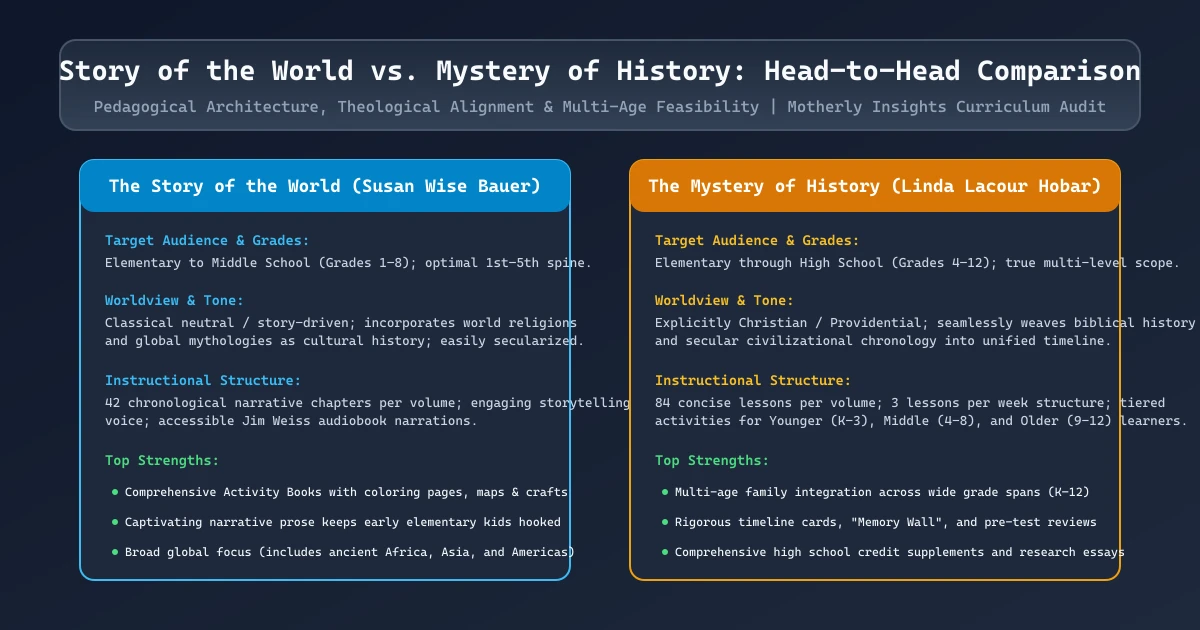
1. Quick Verdict: Which Spine Fits Your Family?
| Core Factor | Choose The Story of the World (SOTW) If… | Choose The Mystery of History (MOH) If… |
|---|---|---|
| Primary Age Band | You are teaching elementary to early middle school students (Grades 1–6). | You are teaching upper elementary, middle school, or high school students (Grades 4–12). |
| Theological Worldview | You prefer a classical/neutral narrative that can be used secularly or easily tailored to your faith. | You desire an explicitly Christian, providential worldview that weaves biblical history directly into world events. |
| Instructional Tone | You want immersive, fable-rich, literary storytelling that captivates younger attention spans. | You want conversational, structured historical commentary paired with memory tools and timeline binders. |
| Family Teaching Model | You prefer short reading sessions paired with comprehensive mapwork, coloring sheets, and hands-on crafts. | You are teaching multiple children across wide grade gaps and need tiered assignments (Younger, Middle, Older). |
| High School Application | Not recommended as a standalone high school spine without massive external supplements. | Complete 4-volume high school syllabus guides with research papers and full Carnegie credit rubrics available. |
2. Worldview & Theological Architecture
The most critical philosophical divergence between Susan Wise Bauer and Linda Lacour Hobar lies in how they interpret human history and religious texts.
The Story of the World: Classical Neutrality & Cultural Storytelling
Susan Wise Bauer, a distinguished classical historian and author of The Well-Trained Mind, approaches history from a classical academic perspective. In Volume 1 (Ancient Times), biblical figures like Abraham, Joseph, and Moses appear alongside Hammurabi, Gilgamesh, and Egyptian Pharaohs.
However, Bauer presents biblical narratives using classical storytelling attribution (“The Hebrew people tell the story of…”), placing them in cultural and geographical context rather than presenting them as inspired dogma.
Furthermore, Volume 1 equally highlights the mythology of ancient Sumer, Norse legends, Native American origin stories, and the epics of ancient India and China.
- Secular Feasibility: High. While not strictly secular (it does not dismiss religious accounts), secular families frequently use Volumes 1 through 4 by discussing myths and religious stories as cultural literature.
- Christian Critique: Some conservative Christian families find the egalitarian treatment of biblical figures alongside pagan mythology uncomfortable.
The Mystery of History: Unapologetic Providential Christian Framework
Linda Lacour Hobar approaches world history through the lens of divine providence. Her guiding thesis is that world history and biblical history are one seamless tapestry.
In Volume 1 (Creation to the Resurrection), the historical narrative begins explicitly at the biblical Creation account. Hobar meticulously synchronizes secular archaeological records with Old Testament chronology. For instance, when studying ancient Mesopotamia, students examine the Tower of Babel; when studying Egypt, they analyze the Exodus alongside archaeological dynasties.
- Theological Tone: Explicitly evangelical and gospel-centered. Hobar frequently addresses the reader directly with spiritual reflections, scripture applications, and moral contemplation.
- Secular Feasibility: Zero. The curriculum is deeply theological; attempting to strip away the Christian worldview would gut the core narrative structure of the text.
3. Four-Year Chronological Scope & Volume Comparison
Both programs follow the classical four-part historical rotation, but their pacing, volume formats, and depth reflect different age progressions:
| Chronological Era | The Story of the World (SOTW) | The Mystery of History (MOH) |
|---|---|---|
| Volume 1: Ancients | Ancient Times: From the Earliest Nomads to the Last Roman Emperor (42 chapters; written for Grades 1–4). Accessible, fairytale-like prose. | Creation to the Resurrection (84 lessons; written for Grades 4–8, adaptable K–12). Chronological synchronization of biblical & world civilizations. |
| Volume 2: Middle Ages | The Middle Ages: From the Fall of Rome to the Rise of the Renaissance (42 chapters; written for Grades 2–5). Introduces feudalism, Islam, knights, and samurai. | The Early Church and the Middle Ages (84 lessons; written for Grades 4–8, adaptable K–12). Deep exploration of church history, Byzantine Empire, and monastic preservation of texts. |
| Volume 3: Early Modern | Early Modern Times: From Elizabeth the First to the Forty-Niners (42 chapters; written for Grades 3–6). Pacing becomes more mature; explores exploration, colonization, and scientific revolution. | The Renaissance, Reformation, and Growth of Nations (84 lessons; written for Grades 5–10). Detailed exploration of theological reformations, geopolitical shifts, and fine arts. |
| Volume 4: Modern Era | The Modern Age: From Victoria’s Empire to the End of the USSR (42 chapters; written for Grades 4–8). Sophisticated treatment of world wars, communism, fascism, and geopolitical treaties. | Wars of Independence to Modern Times (84 lessons; written for Grades 6–12). Heavy, multi-volume textbook with college-prep essays and nuanced 20th-century political history. |
Notice the critical trajectory: SOTW grows slightly with the student (moving from Grade 1 reading level in Vol 1 to Grade 7/8 reading level in Vol 4), but it remains fundamentally an elementary-to-middle school curriculum.
In contrast, MOH starts at a higher baseline (Grade 4) and advances into a robust, dense high school humanities program by Volumes 3 and 4.
4. Lesson Mechanics & Day-to-Day Execution
Daily Life with The Story of the World
A typical week with SOTW centers around one chapter (usually divided into two narrative sections):
- The Read-Aloud: The parent reads 3 to 5 pages aloud, or plays the acclaimed audio edition narrated by professional actor Jim Weiss. The storytelling voice is dramatic, engaging, and rich in character dialogue.
- Oral Narration: Following the reading, the parent uses the questions in the Activity Book to prompt the child for an oral summary (“What did the Nile River provide for the Egyptian farmers?”).
- Mapwork & Coloring: The child colors an outline map (identifying the Fertile Crescent or the Roman Empire) and colors a historical illustration.
- Hands-On Projects: SOTW’s Activity Books are legendary. Families can mummify a chicken in salt, bake Nile mud bricks, sculpt clay cuneiform tablets, or sew a Roman toga.
Daily Life with The Mystery of History
MOH operates on a structured 3-day-a-week schedule (28 weeks per school year, totaling 84 lessons):
- The Lesson Reading: The parent reads aloud or the independent student reads 2 to 4 pages of historical analysis. The tone is conversational but scholarly.
- Tiered Activity Prompts: At the end of every lesson, Hobar provides specific activities tailored to three age brackets:
- Younger Students (Grades K–3): Quick oral discussion, coloring a timeline figure, or simple sensory craft.
- Middle Students (Grades 4–8): Detailed notebooking, creating “Memory Cards” on 3x5 index cards, mapwork exercises.
- Older Students (Grades 9–12): Primary source analysis, biographical essays, philosophical debates, and SAT-style vocabulary drills.
- The Timeline & Memory Wall: MOH emphasizes systematic review. Students build a physical timeline (either accordion-folded or in a 3-ring binder) and complete regular “What Did You Miss?” pre-tests and quarterly reviews to ensure long-term retention.
5. Multi-Student Homeschooling Feasibility
If you have children spanning multiple grades (for example, a 1st grader, a 4th grader, and a 7th grader), managing history requires strategic planning:
| Family Composition | Recommended Spine | Practical Implementation Strategy |
|---|---|---|
| All Early Elementary (K–3rd) | The Story of the World | SOTW is unbeatable for this stage. The stories spark genuine wonder, the audiobooks can be played in the car, and the craft activities keep little hands engaged. MOH Volume 1 is too conceptually dense for most 6-year-olds. |
| Upper Elementary & Middle School (4th–8th) | Either (Tie) | Both work brilliantly here. If you want a neutral literary approach with living books, choose SOTW. If you want systematic timeline review, structured quizzes, and Christian theology, choose MOH. |
| Wide Grade Span (e.g., 2nd + 6th + 9th) | The Mystery of History | MOH is intentionally engineered for this scenario. Read the core lesson to everyone at the breakfast table; then dismiss the 2nd grader with a coloring sheet, have the 6th grader complete mapwork and memory cards, and assign the 9th grader the high school research essay. |
| High School Independent Study (9th–12th) | The Mystery of History | MOH Volumes 3 and 4 include full high school credit syllabi (available from Bright Ideas Press), awarding 1 credit in World History, 1 credit in Church History, and 0.5 credit in English Literature with recommended reading lists. |
6. Audio Editions & Independent Learning
Both curricula offer professional audio recordings, but their production styles cater to different preferences:
- SOTW Audio: Narrated by master storyteller Jim Weiss. Weiss brings history to life with distinct character voices, emotional cadence, and theatrical flair. It is widely considered the gold standard of educational audiobooks and is beloved by children who listen repeatedly for pleasure.
- MOH Audio: Narrated by the author herself, Linda Lacour Hobar. Hobar’s delivery is warm, maternal, gentle, and instructional—like a knowledgeable homeschool mother explaining history at the kitchen table.
7. Cost, Components & Supplementary Investment
To budget accurately for an academic year, examine the required versus optional resources:
The Story of the World Costs (Per Volume)
- Textbook (Paperback or Hardcover): ~$18 – $24
- Activity Book (Mandatory for maps, narration prompts, reading lists, crafts): ~$25 – $35
- Test Book (Optional; useful for 4th–8th grade formal grades): ~$12 – $16
- Jim Weiss Audio MP3 / CDs (Highly recommended): ~$30 – $40
- Total investment per school year: $75 – $115
The Mystery of History Costs (Per Volume)
- Hardcover Student Reader: ~$55 – $80 (Vols 1–4 are substantial, full-color hardcover books)
- Companion Guide (PDF or printed; contains all tiered activities, maps, pre-tests, and rubrics): ~$25 – $40
- Audiobook Downloads: ~$40 – $50
- Timeline Figures & Memory Card Packs (Optional time-saver): ~$15 – $30
- Total investment per school year: $120 – $180
8. Final Synthesis & Expert Recommendation
Neither curriculum is universally superior; their value depends entirely on your family’s theological conviction and the developmental ages of your children.
Choose The Story of the World if your primary students are in kindergarten through 5th grade, if you appreciate classical living books literature, if you want an accessible secular or faith-neutral approach, or if your children thrive on creative, tactile projects like baking bread, carving soap monuments, and acting out historical plays.
Choose The Mystery of History if your family desires an explicitly Christ-centered, providential worldview, if you are teaching multiple children across wide age gaps (especially middle and high school), or if you want an all-in-one humanities spine that systematically prepares older students for rigorous high school transcripts and college-level historical analysis.
Sources & Reference Materials
- Bauer, Susan Wise: The Well-Trained Mind: A Guide to Classical Education at Home. W.W. Norton & Company, 4th Edition.
- Hobar, Linda Lacour: The Mystery of History: Volumes I–IV. Bright Ideas Press.
- Peace Hill Press / Well-Trained Mind Press: The Story of the World: History for the Classical Child (Volumes 1–4).
- Classical Academic Press: The Classical Trivium and Chronological History Framework.