

Disclaimer: This post is for informational and educational purposes only, accurate to the best of our knowledge at publication. It does not constitute advice. We do not guarantee accuracy or completeness and accept no liability for any decisions or losses resulting from reliance on this content.
When homeschooling families transition away from institutional textbooks and look for an all-in-one boxed curriculum, two names consistently top the wish list: Timberdoodle and BookShark.
Both programs deliver a massive cardboard box to your front porch packed with a full year’s worth of award-winning academic resources. Both eliminate the overwhelming stress of piecing together separate vendors for math, science, history, and language arts.
Yet their educational philosophies represent opposite ends of the pedagogical spectrum.
Timberdoodle is the undisputed champion of hands-on, kinesthetic, STEM-rich gameschooling—replacing traditional busywork with robotic building sets, 3D spatial thinking puzzles, and colorful workbooks.
BookShark, by contrast, is the premier secular champion of literature-based learning—anchoring your child’s entire academic world around dozens of captivating historical novels, poetry collections, biographies, and cozy couch read-alouds organized into a structured 4-day school week.
Choosing the wrong box can be costly: an active, tactile 7-year-old forced to listen to three hours of BookShark read-alouds will melt down in tears, while a book-loving 10-year-old handed a box of Timberdoodle engineering blocks may feel starved for immersive storytelling.
This detailed curriculum audit compares learning styles, daily scheduling mechanics, parent involvement, adaptability for neurodivergent learners, and complete annual package pricing.
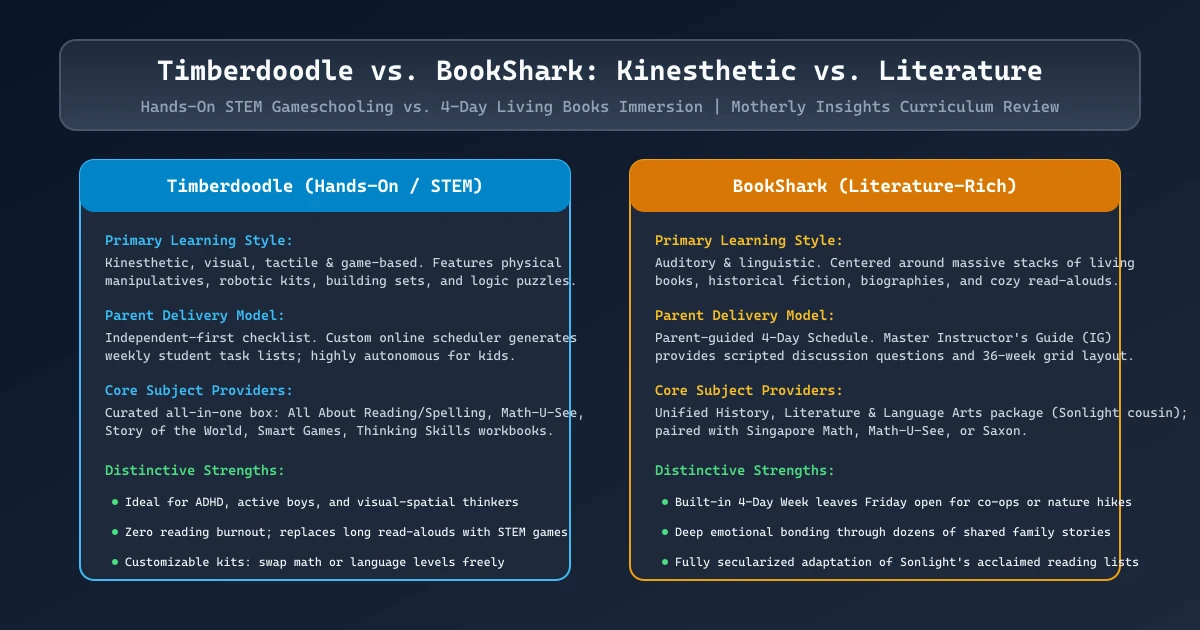
1. Quick Decision Matrix: Which Box Fits Your Family?
| Core Metric | Choose Timberdoodle If… | Choose BookShark If… |
|---|---|---|
| Primary Learning Style | Your child is a kinesthetic, tactile, visual-spatial learner who needs to move, build, and touch. | Your child is an auditory, linguistic, narrative-driven learner who loves listening to stories. |
| Parent Instructional Load | You want an independent-first student checklist where your child works autonomously for 60% of the day. | You want high parent involvement, leading rich literature discussions and shared historical read-alouds. |
| Weekly Schedule | Flexible 5-day custom checklist that allows your student to work at their own pace without rigid dates. | Built-in 4-Day School Week, leaving Fridays completely open for homeschool co-ops, sports, or field trips. |
| Science & STEM Approach | Heavy engineering, robotic construction kits, spatial puzzle games (SmartGames), and sensory science. | Classical, conceptual science with weekly experiment sheets, DVDs/videos, and scheduled science read-alouds. |
| Theological Alignment | Available in both Non-Religious (Secular) and Religious customized kits. | Completely Secular (adapted from Sonlight’s acclaimed literature spine without religious commentary). |
| Average Full-Grade Box Cost | ~$850 – $1,350 (includes all books, games, kits, math manipulatives, and art supplies). | ~$800 – $1,200 (includes all History, Literature, Science, and Math packages + binder). |
2. Pedagogical Architecture: Tactile Logic vs. Living Literature
The Timberdoodle Philosophy: Engineering, Logic & Visual Thinking
Founded in 1985, Timberdoodle operates on a foundational conviction: children learn best when their hands are engaged. Rather than forcing young students to complete static worksheets, Timberdoodle integrates world-class third-party educational products:
- Math: Typically pairs with Math-U-See (famed for its tactile integer blocks) or RightStart Math (abacus and math card games).
- Language Arts: Utilizes All About Reading or Spelling You See, combined with handwriting workbooks and comic-strip style grammar.
- Thinking Skills & STEM: This is Timberdoodle’s signature domain. Every kit includes award-winning multi-level logic puzzles (like SmartGames IQ Puzzler or Camelot Jr), STEM building toys (like K’NEX, Fischertechnik, or Engino models), and visual-spatial workbooks from The Critical Thinking Co.
- Independent Autonomy: Timberdoodle’s custom online scheduler allows parents to input how many weeks they plan to school. It automatically generates a weekly checklist that children can check off themselves, fostering remarkable academic independence.
The BookShark Philosophy: The Living Books Immersion
BookShark is the secular sibling of the historic Christian curriculum Sonlight. It shares Sonlight’s acclaimed 30-year literature lists and legendary Instructor’s Guide (IG), but completely removes Christian theological commentary, making it fully compatible with secular state charter school allotments and secular homeschooling families.
- History / Social Studies: Rather than reading a dry history textbook, your student reads narrative history through the eyes of characters living in that era (e.g., studying ancient Egypt through The Golden Goblet or World War II through Number the Stars).
- Read-Alouds & Readers: Each level includes between 25 and 45 full-length living books. The parent reads complex, emotionally rich novels aloud (Read-Alouds), while the child reads grade-appropriate historical novels independently (Readers).
- The Instructor’s Guide (IG): The heart of BookShark is a massive 3-ring binder containing a 36-week master grid. Open to Week 12, Day 3: it tells you exactly which chapters to read, provides comprehension discussion questions, notes historical vocabulary, and gives cultural background notes.
- The 4-Day Schedule: BookShark is explicitly engineered for a 4-day week (Monday through Thursday). Friday is permanently scheduled as a flex day for makeup work, library visits, or outdoor adventures.
3. A Day in the Life: Daily Scheduling Reality Check
A Typical Morning with Timberdoodle
- Breakfast & Independent Checklists: Your 3rd grader opens their weekly checklist. They see they have 3 pages of Math-U-See, 1 lesson of All About Spelling, 1 level of their Laser Maze logic game, and 30 minutes of science building.
- Short Parent-Led Sessions: You sit with the child for 15 minutes to introduce the new math concept using the manipulative blocks and practice spelling phonograms.
- Autonomous Rotation: While you switch laundry or teach a sibling, the child independently completes their math workbook, plays three challenges of their single-player logic puzzle, and builds a hydraulic crane kit.
- Wrap-Up by Noon: Because hands-on activities keep attention spans laser-focused, academic burnout is minimal, and the entire school day is frequently wrapped up in 2 to 3 hours.
A Typical Morning with BookShark
- The Couch Read-Aloud (45–60 mins): The entire morning starts cozily on the sofa. You open the Instructor’s Guide and read aloud a chapter from the history spine, followed by a chapter from a rich literary novel (e.g., Roll of Thunder, Hear My Cry).
- Socratic Discussion: You use the IG notes to ask thoughtful, open-ended questions about character motivation, historical justice, and geography.
- Language Arts & Mechanics: The student transitions to their language arts binder, completing creative writing prompts and dictation passages pulled directly from the books they are reading.
- Science & Math: The student reads their science book, watches the science demonstration DVD, executes the weekly experiment, and finishes their independent math assignment.
4. Suitability for Neurodivergent Learners (ADHD, Dyslexia, Autism)
Homeschooling parents of neurodivergent children frequently praise one of these two curricula while finding the other unworkable:
| Neurodivergent Profile | Timberdoodle Experience | BookShark Experience |
|---|---|---|
| ADHD / High Energy | Outstanding: Tactile puzzles, short workbook bursts, and physical building sets prevent restlessness and dopamine crashes. | Challenging: Sitting still for 60+ minutes of parent read-alouds can trigger squirming and attention drift unless paired with tactile fidgets or sensory drawing. |
| Dyslexia / Reading Delay | Excellent: Relies heavily on visual, spatial, and tactile demonstration rather than massive reading volume. Uses All About Reading (Orton-Gillingham). | Overwhelming: The pure volume of required reading (30+ chapter books per year) can feel like a mountain of pressure for a struggling dyslexic reader. |
| Twice-Exceptional (2e) & Gifted | Great for Visual-Spatial Thinkers: Advanced logic puzzles and robotics satisfy intellectual curiosity without high handwriting demands. | Exceptional for Deep Thinkers: Emotionally mature living books and complex historical themes provide endless intellectual nourishment. |
5. Customization & Return on Investment (ROI)
Both boxed sets represent a substantial financial investment ($800 to $1,350). However, their resale value and component flexibility differ:
Timberdoodle Customization & Resale
- The “Custom Kit” Feature: Timberdoodle allows parents to customize every component online before purchase. If your 4th grader is doing 5th-grade math and 3rd-grade spelling, you can alter the levels within the cart and keep the package discount.
- Non-Consumable STEM Games: The SmartGames, robotic kits, and spatial puzzles do not get consumed; they can be passed down to younger siblings for years or resold on homeschool classifieds for 60% to 70% of retail value.
BookShark Family Reusability & Resale
- The Ultimate Multi-Child Investment: Once you own a BookShark Level (e.g., Level D: American History Part 1), you own 40+ permanent living books for your home library. You only need to purchase a fresh consumable Student Activity Sheet packet (~$30) to reuse the entire $800 curriculum for a younger child years later.
- Massive Resale Demand: BookShark Instructor’s Guides and book sets hold exceptional resale value on homeschool forums and Facebook buy-and-sell groups.
6. Final Verdict: The Deciding Questions
Choose Timberdoodle If:
- Your child is an active, kinesthetic learner who loves building blocks, puzzles, and interactive STEM gadgets.
- You want to foster independent learning habits and need a student-led checklist routine.
- You have a child with ADHD, dysgraphia, or dyslexia who experiences fatigue from heavy reading loads.
- You want an eclectic, multi-publisher box that cherry-picks the finest tactile programs on the market.
Choose BookShark If:
- Your family loves stories and treasures quiet, cozy hours of shared read-alouds on the couch.
- You want a structured, pre-planned 4-day academic week that leaves your Fridays free.
- You want a fully secular, deep dive into world and American history taught through diverse human perspectives.
- You want an incredible home library of classic and contemporary literature that your children will remember into adulthood.
Sources & Reference Materials
- Timberdoodle Co.: Curriculum Planners, STEM Kit Catalogs, and Thinking Skills Frameworks.
- BookShark LLC: 4-Day Literature-Based Curriculum Guides & Scope and Sequence.
- International Dyslexia Association: Multisensory and Kinesthetic Instructional Principles.
- American Library Association (ALA): Notable Children’s Books and Historical Fiction Recommendations.
Frequently Asked Questions: Timberdoodle vs BookShark
What is the primary difference between Timberdoodle and BookShark?
Timberdoodle is a multi-sensory curriculum kit emphasizing hands-on STEM engineering toys, logic games, and independent workbooks. BookShark is a literature-rich curriculum centered on daily family read-alouds, historical fiction living books, and a 4-day weekly schedule.
Are Timberdoodle and BookShark secular?
BookShark is completely secular. Timberdoodle offers both customized secular curriculum kits and religious curriculum kits, allowing parents to select packages that match their educational philosophy.
Which curriculum requires more daily parent involvement?
BookShark requires substantial daily parent reading time (typically 1.5 to 2 hours of reading aloud and discussion). Timberdoodle emphasizes independent learning tools, puzzles, and self-directed workbooks that reduce direct parent instruction.