

Disclaimer: This post is for informational and educational purposes only, accurate to the best of our knowledge at publication. It does not constitute advice. We do not guarantee accuracy or completeness and accept no liability for any decisions or losses resulting from reliance on this content.
In 2021, the West Virginia Legislature enacted the Hope Scholarship Act (W. Va. Code § 18-31-1 through § 18-31-13), establishing one of the most comprehensive and flexible Education Savings Account (ESA) programs in the United States. Following a decisive 2022 Supreme Court of Appeals of West Virginia ruling that confirmed the program’s full constitutionality, thousands of Mountain State families have utilized Hope Scholarship funds to customize their children’s education.
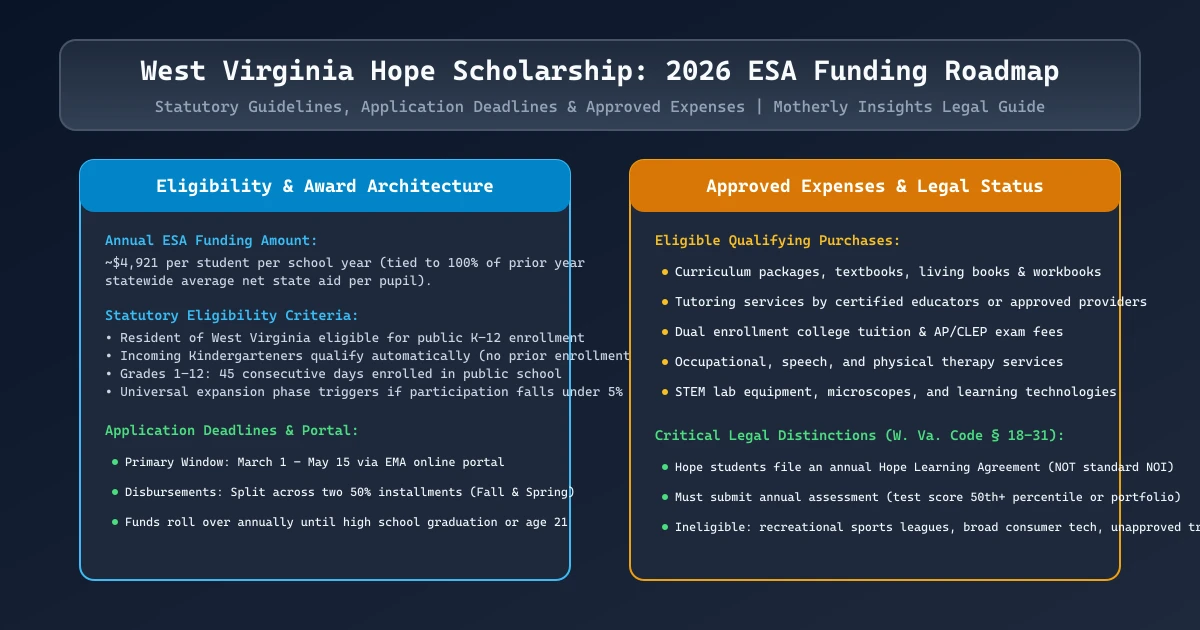
For homeschooling parents, the Hope Scholarship provides approximately $4,921 per student per school year in flexible educational funding. These state-deposited funds can be utilized to purchase comprehensive boxed curricula, hire licensed tutors and therapists, pay for dual-enrollment college coursework, acquire laboratory science equipment, and pay for standardized testing fees.
However, participating in the Hope Scholarship establishes a distinct legal status. Hope recipients operate under W. Va. Code § 18-31, which imposes specific annual agreement filings, spending restrictions, and academic assessment submissions that differ significantly from standard West Virginia independent homeschooling under W. Va. Code § 18-8-1(c).
This legal and practical roadmap—authored by homeschool statutory compliance counsel—explains eligibility gateways, the 45-day public school enrollment rule, approved vs. prohibited purchases, the Education Market Assistant (EMA) portal, and how to maintain total legal compliance.
1. How Much Funding Does the Hope Scholarship Provide?
The Hope Scholarship is funded through an Education Savings Account administered by the West Virginia State Treasurer’s Office and overseen by the Hope Scholarship Board.
Under W. Va. Code § 18-31-6, the annual scholarship amount is calculated as 100% of the prior year’s statewide average net state aid per pupil.
| Academic School Year | Annual Award Per Student | Disbursement Schedule | Unused Funds Policy |
|---|---|---|---|
| 2024–2025 | $4,921.39 | 50% Fall (August) / 50% Spring (January) | Rolls over automatically to next academic year. |
| 2025–2026 | ~$4,988 (Estimated) | 50% Fall (August) / 50% Spring (January) | Accumulates until high school graduation or age 21. |
| 2026–2027 | Projected ~$5,050+ | 50% Fall (August) / 50% Spring (January) | Surplus funds return to the state upon program exit. |
Funds are deposited digitally into the family’s account on the Education Market Assistant (EMA) online management platform. Parents do not receive direct cash or debit cards; purchases are completed through an approved digital vendor marketplace or via parent reimbursement requests backed by itemized educational receipts.
2. Who is Eligible? (The 45-Day Public School Rule vs. Kindergarten)
Understanding eligibility is the most common hurdle for West Virginia families considering the transition from public school to home education:
1. Incoming Kindergarten Students
Any child who is a resident of West Virginia and reaches age 5 on or before June 30 of the enrollment year qualifies for the Hope Scholarship automatically. They do not need prior public school attendance.
2. Elementary, Middle, and High School Students (Grades 1–12)
Under current statute, a student in grades 1 through 12 must have been enrolled full-time in a West Virginia public elementary or secondary school for at least 45 consecutive calendar days immediately preceding the date of application.
3. Currently Homeschooled Students (The Universal Expansion Trigger)
Under W. Va. Code § 18-31-12, the statute contains a universal expansion clause: if the total number of Hope Scholarship recipients is less than 5% of the statewide net public school enrollment in any given year, the program is scheduled to open to all West Virginia children, including existing homeschoolers and private school students, beginning in the 2026–2027 school year.
Families currently homeschooling under standard statutory notice should monitor the Hope Scholarship Board’s annual January enrollment census to confirm if the universal expansion window is open for the upcoming academic cycle.
3. Approved vs. Prohibited Qualifying Educational Expenses
The Hope Scholarship Act (W. Va. Code § 18-31-7) strictly limits qualifying expenses to bona fide educational goods and services. Understanding what passes board audit ensures smooth reimbursements:
Approved Qualifying Expenses (Green Light)
- Comprehensive Homeschool Curricula: Boxed curriculum sets (e.g., Timberdoodle, BookShark, All About Reading, Math-U-See, Singapore Math, Saxon).
- Textbooks & Living Books: Educational non-fiction, historical literature, classic literature, and science reference texts.
- Supplemental Academic Materials: Workbooks, phonics cards, math manipulatives (base-ten blocks, abacuses), and educational software subscriptions.
- Accredited Tutoring Services: Individualized academic tutoring provided by a certified teacher or a state-approved educational tutoring vendor.
- Therapies for Special Needs: Physical, occupational, or speech-language therapy provided by licensed clinical specialists.
- Dual Enrollment College Tuition: Tuition, academic fees, and textbooks for college coursework completed through West Virginia university or community college programs.
- Standardized Testing & Examination Fees: Fees for nationally standardized achievement tests (Iowa, Stanford, TerraNova), Advanced Placement (AP) exams, and College Board CLEP test registrations.
- STEM & Science Lab Hardware: Microscopes, dissection kits, chemical titration sets, and specialized robotics components directly tied to a science curriculum.
Prohibited Expenses (Red Light)
- General household consumer electronics (televisions, standard home gaming consoles, smartphones).
- Family vacations, general travel expenses, lodging, food, and fuel.
- Extracurricular recreational sports league fees (community soccer, Little League) that are not part of an accredited physical education curriculum.
- Furniture, standard desks, lighting, home construction, or domestic renovations.
- Capital equipment or consumer items that can be diverted for general adult household use.
4. Legal Status: Hope Scholarship vs. Standard WV Homeschooling
A critical statutory distinction exists between schooling with the Hope Scholarship versus schooling under standard West Virginia homeschool law:
| Statutory Feature | Standard WV Homeschool (W. Va. Code § 18-8-1(c)) | Hope Scholarship Home Education (W. Va. Code § 18-31) |
|---|---|---|
| Notice of Intent (NOI) | Must file a one-time Notice of Intent with the county superintendent upon commencing homeschooling. | Must file the formal Hope Learning Agreement and annual renewal through the state portal. |
| Academic Oversight | County school board has minimal administrative oversight; no curriculum pre-approval. | Subject to state Hope Scholarship Board financial auditing and educational plan verification. |
| Required Assessment | Annual assessment required; submit results to county superintendent in grades 3, 5, 8, and 11 only. | Annual assessment required every single year. Results must be submitted annually via the EMA portal to renew funding. |
| State Funding | $0.00 (Self-funded by family). | ~$4,921 per year per student. |
| Curriculum Autonomy | Total sovereign parental choice; can teach any worldview, religion, or methodology. | Total parental curricular choice, provided materials meet statutory definitions of basic educational instruction. |
If a family ever decides to forfeit their Hope Scholarship, they simply notify the board, file standard Form 18-8-1(c) Notice of Intent with their local county superintendent, and transition to standard independent homeschooling.
5. Annual Assessment & Academic Accountability
To maintain Hope Scholarship funding year over year, parents must provide proof of academic progress annually by June 30.
Parents have two legally recognized options to satisfy this mandate:
Option 1: Nationally Norm-Referenced Standardized Testing
The student completes an approved standardized test (such as the Iowa Assessments (Form E), Stanford 10, TerraNova, or California Achievement Test (CAT)).
- The test must assess reading, language arts, and mathematics.
- The student must score at or above the 50th percentile composite score, or demonstrate academic progress consistent with their individual ability level.
Option 2: Certified Teacher Portfolio Review
The parent compiles a portfolio of the student’s work across the core subjects (reading, language arts, mathematics, science, social studies).
- A certified West Virginia teacher (or a certified educator holding valid credentials in another state) reviews the portfolio and student interview.
- The teacher signs a formal written narrative evaluation certifying that the student is demonstrating academic progress commensurate with their age and ability.
- This portfolio review letter is uploaded directly into the EMA portal.
6. How to Apply: Key Deadlines & The EMA Portal
The Hope Scholarship application process is managed entirely online via the Education Market Assistant (EMA) portal at hopescholarshipwv.com.
The Annual Application Timeline:
- March 1: Primary application window opens for the upcoming academic year.
- May 15: Primary application deadline for full-year funding. (Applications submitted between May 16 and November 30 are evaluated on a prorated semester basis depending on state fund availability).
- June 15: The Hope Scholarship Board issues formal award notifications via email.
- July 1 – August 1: Parents accept the award agreement digitally and complete their student’s individualized educational plan.
- Mid-August: First 50% tuition/curriculum deposit is funded into the student’s EMA digital wallet.
- January: Second 50% semester deposit is funded.
7. Summary & Best Practices for Mountain State Families
The West Virginia Hope Scholarship represents a historic opportunity for home educators to provide an elite, customized academic experience without bearing an overwhelming financial burden.
By establishing an organized record-keeping system—maintaining itemized receipts, monitoring the EMA marketplace, scheduling standardized testing early in the spring, and submitting the annual evaluation before June 30—your family can maximize state funding while protecting your educational autonomy.
Sources & Statutory Citations
- West Virginia Legislature: West Virginia Code Chapter 18, Article 31 (The Hope Scholarship Act).
- West Virginia State Treasurer’s Office: Hope Scholarship Board Operating Regulations and Approved Expense Guidelines.
- Supreme Court of Appeals of West Virginia: State of West Virginia ex rel. v. Beaver, 875 S.E.2d 202 (W. Va. 2022) (Constitutional Validation Opinion).
- West Virginia Department of Education (WVDE): Non-Public and Home School Compulsory Attendance Statistics.