

The single most persistent myth in American education is that home educating requires a stay-at-home parent standing in front of a chalkboard from eight o’clock in the morning until three o’clock in the afternoon[1].
When institutional schools closed during 2020, millions of dual-income corporate managers, remote tech workers, nurses, accountants, and single parents discovered a fundamental truth: the institutional six-hour school day contains fewer than two hours of actual academic instruction[4]. The remainder of the traditional classroom day is consumed by roll calls, hallway transitions, crowd management, behavioral discipline, and waiting for twenty-eight other students to turn to page forty-two.
According to research from the National Home Education Research Institute (NHERI), over one-third of homeschooling households now feature either two working parents or a single working head of household[1].
You do not need to quit your career, liquidate your savings, or sacrifice professional ambitions to give your children a world-class, personalized home education. What you need is not more hours in the day—it is an operational management framework that decouples academic mastery from artificial clock-watching.
The Legal Reality: When Must Homeschooling Happen?
Parents considering this path frequently ask with deep anxiety: “Is it legal to homeschool my child on Saturday mornings or Tuesday evenings after work?”
The answer across all fifty United States is an unequivocal yes[2].
State compulsory education laws (such as Texas Education Code § 25.085, California Education Code § 48222, and Florida Statutes § 1002.41) require parents to provide regular instruction in mandatory academic subjects. However, not a single state statutory code dictates that instruction must occur between 8:00 AM and 3:00 PM Monday through Friday[2].
Core Legal Operating Tenets for Working Parents:
- Clock Hours vs. Competency Mastery: In low-regulation states (e.g., Texas, Illinois, New Jersey), the law measures genuine learning and good-faith instruction, not hourly timecards. In moderate-to-high regulation states requiring 180 days or 900 annual hours (e.g., Pennsylvania, New York, Missouri), educational hours encompass reading aloud before bedtime, Saturday science museum field studies, family budgeting, and audiobooks during commutes.
- Third-Party Supervision & Tutors: State statutes universally permit parents to designate tutors, enroll children in hybrid micro-schools, utilize co-ops, or place children with grandparents or babysitters while working during the day. The parent retains ultimate legal accountability for curriculum direction and assessment records[2].
The Three High-Yield Operating Models for Working Parents
Every working family operates under unique professional constraints[3]. A remote software engineer has vastly different scheduling flexibility than an emergency room nurse working twelve-hour weekend shifts.
Here are the three proven architectural models used by successful working homeschoolers:
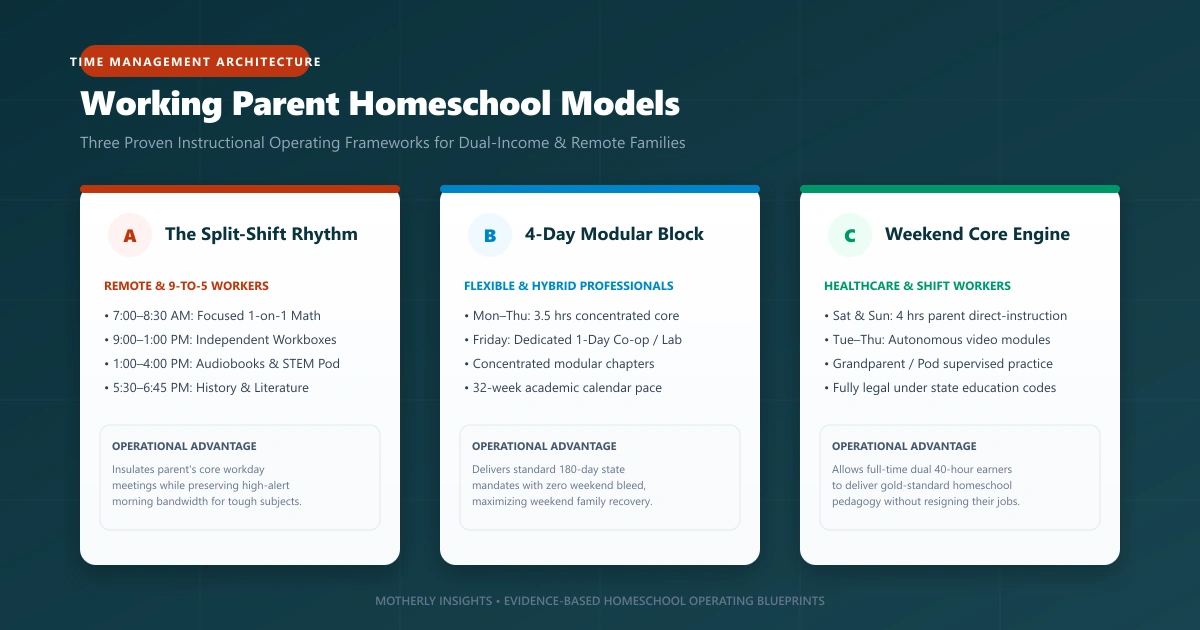
Model A: The Split-Shift Rhythm (Remote & 9-to-5 Professionals)
Designed for parents who work standard corporate hours from home or have hybrid office schedules[3]. Direct parent instruction is frontloaded early and closed out in the evening, leaving daytime hours for quiet, autonomous student execution.
- 7:00 AM – 8:30 AM (The Morning Sprint): Direct, intensive parent-child instruction in high-friction core subjects: Phonics/Reading for early elementary, or Algebra/Geometry for older students[3]. The parent is fully present before opening work laptops or checking corporate email.
- 9:00 AM – 1:00 PM (Autonomous Workbox Window): The student executes independent assignments: handwriting practice, silent literature reading, educational math software, typing drills, and art projects[3]. The parent works in their home office.
- 1:00 PM – 4:00 PM (Enrichment & Rest): Physical outdoor play, documentary viewing, library visits, or local homeschool pod activities.
- 5:30 PM – 6:45 PM (The Twilight Session): Family history read-aloud, dinner table current events discussion, or hands-on science experiment review.
Model B: The 4-Day Modular Block (Flexible & Hybrid Earners)
Rather than diluting schoolwork across five fragile days, parents compress academic instruction into four focused days (Monday through Thursday), reserving Friday for dedicated co-op immersion or collaborative workdays.
- Instructional Density: 3 to 3.5 hours of daily concentrated work easily fulfills standard state guidelines.
- Co-op Outsourcing: On Fridays, children attend a full-day homeschool tutorial or STEM academy where parent volunteers or hired instructors handle laboratory sciences, foreign languages, and group performing arts.
- Weekend Preservation: Saturdays and Sundays remain 100% sacred for family rest and rejuvenation, preventing parental burnout.
Model C: The Weekend-Shift Asynchronous Track (Healthcare & Shift Workers)
Tailored for nurses, firefighters, retail managers, and dual-earner parents who work nontraditional shifts.
- Saturday & Sunday (Parent Core Engine): The parent delivers 4 hours of direct, joyful teaching each weekend morning when work shifts are off.
- Tuesday – Thursday (Autonomous Execution): The student completes follow-up problem sets, independent reading, and pre-recorded video lectures under the supervision of a grandparent, spouse on opposite shift, or trusted child-care provider.
Building an Autonomous Learning Infrastructure
The secret to working while homeschooling does not lie in multitasking—trying to teach fractions while responding to Slack messages is a guaranteed recipe for frustration[3]. The solution lies in scaffolding autonomy so that your child can work without constant parental intervention.
The Working Parent Autonomous Learning Checklist
- 1[3]. The 10-Drawer Workbox Tower: Stacked plastic drawers containing one closed task each (e.g., Drawer 1: 15 minutes of handwriting; Drawer 2: Math review worksheet)[3]. When a drawer is empty, the student moves to the next.
- 2[3]. Color-Coded Help Cups: A green cup on the desk signals "I am working independently." A red cup signals "I am stuck, but I will skip this problem and keep working until mom finishes her call."
- 3[3]. Asynchronous Self-Paced Curricula: Integrate programs with high-quality pre-recorded video teaching (such as [Math-U-See](/saxon-math-vs-math-u-see-homeschool-comparison/), Teaching Textbooks, or CTCMath) to handle instruction during business hours.
- 4[3]. Weekly Sunday Batch Planning: Print all worksheets, prepare science lab kits, and bookmark video links every Sunday evening to eliminate Monday morning decision fatigue.
Selecting Low-Prep, High-Autonomy Curricula
Working parents must deliberately avoid parent-intensive, highly scripting curricula that demand thirty minutes of manual teacher prep per lesson.
| Subject | Highly Recommended for Working Parents | Why It Works | Curricula to Avoid for Working Parents |
|---|---|---|---|
| Mathematics | Teaching Textbooks or Math-U-See | Automated grading, clear video lectures, step-by-step video solutions. | RightStart Math (Requires 45 min of 1-on-1 parent interaction per lesson). |
| Language Arts | Essentials in Writing (EIW) or Logic of English (Online) | Bite-sized video lessons; students watch a 5-minute video and execute the assignment independently. | Brave Writer (Demands intensive parental discussion and open-ended coaching). |
| History & Science | Story of the World (Audiobook) & Mystery Science | Students listen during lunch or quiet time; open-and-go digital science experiments. | Five in a Row (Requires extensive daily parent library curation and scripting). |
| Foreign Language | TalkBox.Mom or Babbel | Audio-driven immersion that integrates into daily routines without formal grammar lectures. | Traditional grammar-translation textbooks that require parental fluency. |
Outsourcing and Community Scaffolding
No working parent can do it all in isolation[3]. High-performing working homeschoolers treat their children’s education like a boutique enterprise, leveraging community assets strategically:
1[3]. The 2-Family Co-op Swap
Partner with another homeschooling family[3]. On Tuesdays, your neighbor teaches history, geography, and art to both your children and hers for four hours while you work undisturbed[3]. On Thursday evenings or Saturdays, you host both families’ kids for a hands-on STEM and coding workshop while your neighbor gets personal time[3]. Zero tuition dollars spent; four to eight hours of quiet professional focus gained.
2[3]. Homeschool Hybrid Micro-Schools
In almost every metropolitan area, hybrid schools and learning pods operate two to three days per week (e.g., Tuesdays and Thursdays from 9:00 AM to 2:00 PM)[3]. Professional educators deliver classroom instruction, peer collaboration, and lab experiments, while the student completes assigned coursework at home on the alternate days.
3[3]. Coworking Spaces with Child Enrichment
A growing trend among remote workers is joining family-focused coworking communities[3]. These facilities feature soundproof executive conference rooms and high-speed internet on one floor, alongside supervised Montessori playrooms, tutoring corners, and art studios on the lower floor.
Overcoming Burnout & Setting Realistic Boundaries
The greatest threat to a working homeschool family is not academic stagnation—it is parental exhaustion[3]. When you work forty hours a week and carry primary instructional responsibility, you risk running on emotional fumes unless you establish strict psychological boundaries.
- Abandon the Comparison Trap: Stop looking at stay-at-home homeschooling influencers on social media who spend five hours baking sourdough while hand-painting watercolor nature journals[3]. Your child does not need perfection; they need a stable, loving parent who teaches them resourcefulness, discipline, and authentic problem-solving.
- Year-Round Modular Pacing: Rather than cramming 180 days of academic pressure into nine grueling months, transition to a year-round schedule (e.g., six weeks on, one week off, with an extended four-week summer break)[3]. This spreads the academic load evenly, reducing daily instructional requirements to just 90 to 120 minutes per day.
- Automate Household Chores: Chores are not a distraction from home education; they are foundational executive function training[3]. Teach your children to do their own laundry, prepare simple lunches, and vacuum shared spaces[3]. By age eight, a child can independently pack their workboxes and clear the kitchen table.
💡 Related Educational Pathways: To compare related legal frameworks and recommended study programs, explore our detailed reviews on California homeschool legal guidelines, Ohio homeschool notification regulations, Pennsylvania Act 169 requirements.
Frequently Asked Questions About Homeschooling While Working
Can a single working parent legally homeschool? ↓
How many hours a day does homeschooling actually take? ↓
What do my kids do while I am on important work Zoom calls? ↓
Will my child fall behind academically if I don't teach all day? ↓
Disclaimer: This post is for informational and educational purposes only, accurate to the best of our knowledge at publication[3]. It does not constitute advice[3]. We do not guarantee accuracy or completeness and accept no liability for any decisions or losses resulting from reliance on this content.