There is a profound, irreversible shift that occurs in a child’s understanding of the world when they stand inside the Roman Colosseum, tracing their fingers along ancient travertine limestone, rather than reading three dry paragraphs on page seventy-four of a middle-school textbook[1].
Worldschooling is not an extended vacation. It is a deliberate, experiential educational philosophy that views the entire planet as a primary classroom[4]. Instead of confining learning to a desk, worldschooling families immerse their children in living history, marine biodiversity, foreign language acquisition, and global economic realities through intentional travel.
Yet for all its romantic allure on social media, successful worldschooling requires rigorous operational discipline. You cannot simply board an international flight and assume everything will fall into place.
To worldschool successfully without legal jeopardy, academic neglect, or parental exhaustion, you need a bulletproof framework addressing legal domicile residency, zero-weight academic tools, and international visa pacing.
The Legal Anchor: Establishing State Domicile
The most urgent legal question every aspiring worldschooling family must resolve is: Under whose laws does our homeschooling operate when we are in Portugal, Thailand, or Japan?
Under international law and bilateral treaties, foreign nations exercise compulsory school attendance authority primarily over their legal residents and citizens, not temporary foreign tourists traveling on tourist visas[1][2]. While you are traveling internationally, your primary legal educational obligation remains anchored to your home country and state of legal domicile[1].
Selecting a Nomad-Friendly U.S[2]. Anchor State
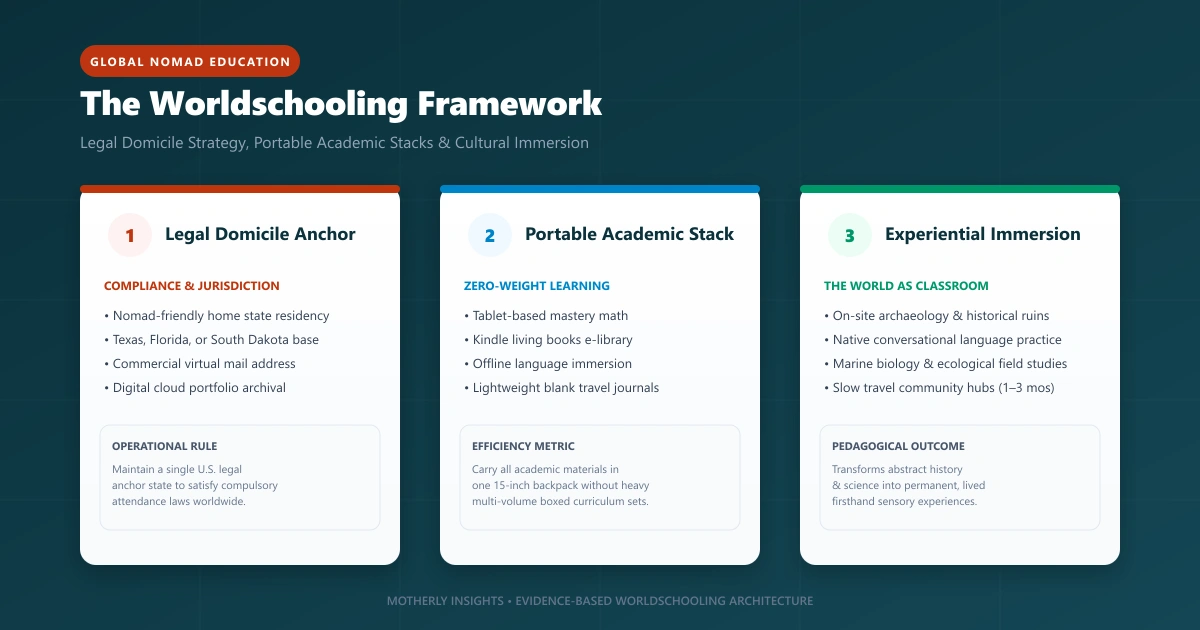
Before relinquishing a physical house or apartment lease in high-regulation states (like New York, Pennsylvania, or Massachusetts), full-time nomadic families deliberately establish legal domicile in a nomad-friendly, zero-income-tax state with low or non-existent homeschool reporting requirements:
- South Dakota (The Nomad Gold Standard): South Dakota statutory law (SDCL § 13-27-3) allows full-time travelers to establish legal state residency and voter registration after spending just one night in the state at a local campground or hotel[2]. By utilizing a commercial mail-forwarding provider (such as in Sioux Falls or Rapid City), parents submit a simple one-time alternative instruction notification, completely exempt from testing or reporting.
- Texas: Texas operates under the landmark Leeper v. Arlington ISD precedent, treating home schools as unaccredited private schools with zero state registration, zero portfolio evaluations, and zero state notifications.
- Florida: By enrolling under a Florida non-traditional private “umbrella school” (such as The Farm School or Home Life Academy), families can travel globally for years while remaining legally compliant private school students under Florida law.
The Hague Apostille for High School Transcripts
If your high schooler plans to apply to international universities or re-enter traditional secondary schools overseas, standard parent-issued transcripts may require international authentication.
Under the 1961 Hague Apostille Convention, you have your parent-issued transcript notarized by a notary public in your legal domicile state, and then submitted to that state’s Secretary of State office for an official Hague Apostille Certificate[3]. This legal certification is universally recognized across more than 120 member countries worldwide.
The Zero-Weight Portable Academic Stack
Traveling with three children, six carry-on bags, and forty pounds of heavy multi-volume boxed curriculum sets is an operational nightmare. High-performing worldschoolers adopt a zero-weight, cloud-synchronized academic stack:
The Nomadic Minimalist Curriculum Stack
- Core Mathematics (Tablet-Based): Utilize self-paced mastery math programs with downloadable offline lessons (such as Teaching Textbooks, [Math-U-See](/saxon-math-vs-math-u-see-homeschool-comparison/) Digital, or CTCMath). A tablet downloads 10 lessons before long train rides or flights.
- Living Books E-Library (Kindle Paperwhite): Load each child's Kindle with hundreds of historical fiction novels, biographies, and classic literature. High e-ink readability in bright sunlight with zero luggage weight.
- Micro-Science & Nature Journaling: Replace bulky laboratory equipment with portable field tools: a pocket LED 100x microscope, waterproof field sketchbooks, and a compact watercolor travel pan.
- Language Immersion (Native Environment): Combine digital apps (Duolingo, Babbel) with mandatory real-world daily practice: ordering meals in local markets, counting currency, and conversational exchanges with local youth.
What to Protect: The 90-Minute Daily Core
Do not attempt to replicate a standard six-hour school day while traveling. When you are visiting the Acropolis or snorkeling in a barrier reef, you are already delivering rich experiential learning.
Protect just 90 minutes each morning for linear skills that do not naturally absorb through osmosis:
- 45 minutes of sequential mathematics.
- 45 minutes of focused reading, phonics, or written journaling.
Once that 90-minute foundational anchor is complete, close the laptops and step out into the world.
The Three Operating Models of Worldschooling
Families balance academics and travel using three distinct operational models:
1. Slow-Travel Hub Immersion (1 to 3 Months per Base)
Rather than changing hotels every three days, slow-travel families rent a furnished apartment or villa in one city for one to three months.
- Predictable Routine: Children establish a reliable morning school rhythm, make friends at local parks, join sports clubs, and take weekly language lessons.
- Cost Efficiency: Monthly rentals on platforms like Airbnb or local lease agencies offer 30% to 50% discounts compared to nightly rates.
- Global Hubs: Popular worldschooling hubs with thriving international nomad communities include Oaxaca (Mexico), Bansko (Bulgaria), Bali (Indonesia), and Chiang Mai (Thailand).
2. The Integrated Expedition Track
Ideal for families doing targeted historical or scientific pilgrimages (e.g., following the Lewis and Clark trail across the American Northwest, or tracing the Silk Road across Central Asia).
- Coursework is directly synchronized with the itinerary.
- While in Florence, students read Vasari’s Lives of the Artists and study perspective drawing; while in the Galápagos Islands, they read Charles Darwin’s original journals and document tortoise adaptations.
3. The Seasonal Home-Base Model
Families maintain an affordable home base for six to eight months of the year (often during autumn and winter for routine sports and co-ops) and spend three to four months embarking on extended international expeditions. This provides a balance between deep community roots and exhilarating global adventure.
Navigating Visa Logistics: The Schengen Pacing Puzzle
For American and Canadian passport holders traveling through Europe, understanding the Schengen Area 90/180-day rule is vital to avoiding steep fines or deportation:
- U.S. citizens can spend a maximum of 90 days within any rolling 180-day period inside the Schengen Zone (which encompasses 29 European countries, including France, Italy, Germany, Spain, and Greece).
- Once your 90 days are consumed, your family must exit the Schengen Zone for at least 90 consecutive days.
The “Schengen Shuffle” Strategy:
Nomad families master the rhythm of alternating between Schengen and non-Schengen destinations:
- Months 1–3: Schengen Zone (e.g., three months renting a stone cottage in rural France and exploring Renaissance Italy).
- Months 4–6: Non-Schengen Countries (e.g., three months exploring the rich history of the United Kingdom, Albania, Turkey, or Morocco).
- Months 7–9: Re-enter the Schengen Zone with a completely refreshed 90-day tourist allowance.
Managing Socialization & Digital Nomad Community
The single greatest emotional challenge for traveling children is the longing for enduring, predictable peer friendships. High-travel families overcome this through deliberate community scaffolding:
- Worldschooling Pop-Up Hubs: Organizations and community collectives (such as Worldschool Pop-Up Hub and Deliberate Detour) organize two-week temporary gatherings worldwide. Ten to twenty traveling families converge on a location—such as Split, Croatia or Granada, Spain—renting nearby flats, conducting group field trips, and hosting daily adolescent hangouts.
- Global Discord & Minecraft Servers: Nomad kids maintain daily voice chats, gaming sessions, and book clubs with other traveling friends across international time zones.
- Local Community Immersion: Enroll your children in local non-verbal or universal community activities: Brazilian Jiu-Jitsu, swim teams, art studios, and chess clubs. Play is a universal language; children routinely bridge cultural divides within fifteen minutes on a public playground.
💡 Related Educational Pathways: To compare related legal frameworks and recommended study programs, explore our detailed reviews on California homeschool legal guidelines, Ohio homeschool notification regulations, Pennsylvania Act 169 requirements.
Frequently Asked Questions About Worldschooling
Is worldschooling legal if foreign countries have strict homeschool bans? ↓
How much does worldschooling cost compared to living at home? ↓
Will worldschooling harm my student's chances of entering competitive colleges? ↓
What do we do about reliable internet access for digital schoolwork? ↓
Disclaimer: This post is for informational and educational purposes only, accurate to the best of our knowledge at publication. It does not constitute advice. We do not guarantee accuracy or completeness and accept no liability for any decisions or losses resulting from reliance on this content.